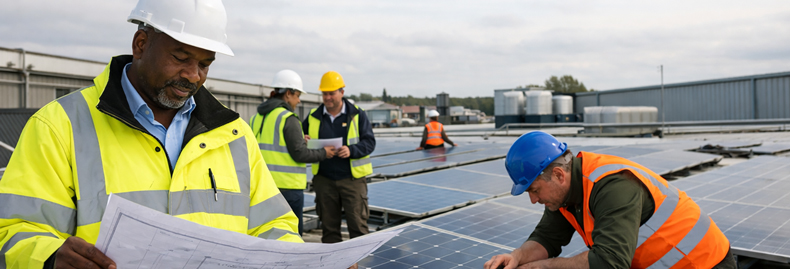
Why warehouses are often considered for solar
Warehouses typically offer large roof areas and consistent daytime energy use, which makes them suitable candidates for solar systems. At the same time, their scale and construction introduce specific considerations that need to be understood before installation.
Wide spans and structural behaviour
Many warehouse roofs are designed with wide spans and lightweight materials. This allows for large open floor areas, but it also means the structure may behave differently under additional load. The distribution of weight, rather than just the total amount, becomes important.
Steel portal frames, purlins, and cladding systems all play a role in how loads are transferred. Understanding how these elements work together helps determine whether additional reinforcement or design adjustments are required.
Roof coverings and durability
Warehouse roofs often use metal sheeting or composite panels. These materials perform well in general use but can be sensitive to how loads and fixings are applied. Previous repairs, ageing coatings, or minor deformation may not be obvious at ground level.
Condition surveys help identify whether the roof is suitable for long-term use with a solar system in place.
Fire load and stored goods
Warehouses frequently store goods that vary in type and fire risk. High racking systems and dense storage can influence how a fire develops within the building. This means that fire safety considerations extend beyond the roof itself.
Solar installations are therefore considered in the context of the building’s overall fire profile, including access routes and emergency response.
Operational activity and access
Warehouse sites are usually active environments, with vehicle movements, loading bays, and staff working throughout the day. Installation and maintenance need to be planned so that these activities can continue safely.
Access to the roof, positioning of lifting equipment, and separation of work areas all form part of how risks are managed during both installation and ongoing use.
Wind exposure on large roof areas
Large, uninterrupted roof surfaces can be more exposed to wind effects. Edge zones and corners may experience higher uplift forces, particularly on buildings located in open areas or near the coast.
System design takes these conditions into account so that panels remain stable under expected wind loads.
Electrical systems within operational spaces
In warehouses, electrical infrastructure often runs alongside storage and handling operations. The integration of solar systems needs to consider how equipment is positioned and protected within this environment.
Inverters, cabling routes, and isolation points are usually arranged so that they do not interfere with normal activity.
Maintenance alongside ongoing use
Access for inspection and maintenance needs to be practical without disrupting operations. This may involve designated access routes, planned maintenance windows, or coordination with site management.
Warehouses often operate to tight schedules, so maintenance planning becomes part of the overall system design.
How these risks are usually addressed
Warehouse-specific risks are typically managed through a combination of structural assessment, design adjustments, and operational planning. When these factors are considered together, solar systems can be integrated into warehouse buildings in a way that aligns with both structural performance and day-to-day use.